Java Virtual Threads Interview Questions & Answers 2026
Picture this: you’re in round two at an EPAM or a well-funded fintech startup, and the interviewer leans forward and says, “Tell me about virtual threads — and don’t just tell me they’re lightweight.” That moment is coming more often than you think. Since Java 21 made virtual threads a production-ready feature (JEP 444), interviewers at product companies and even large SIs like TCS and Infosys have started slipping them into backend developer rounds.
⏱️ 11 min read | 📚 Updated June 2026
💡 Quick Tip: Need fast answers? Jump directly to the FAQ section below.
This guide is for Java developers with 2-6 years of experience who know threads exist but haven’t gone deep on Project Loom yet. By the end, you’ll be able to explain virtual threads, carrier thread pinning, the difference from platform threads, and the gotchas that trip up even experienced engineers — all in interview-ready language backed by real code.
Table of Contents
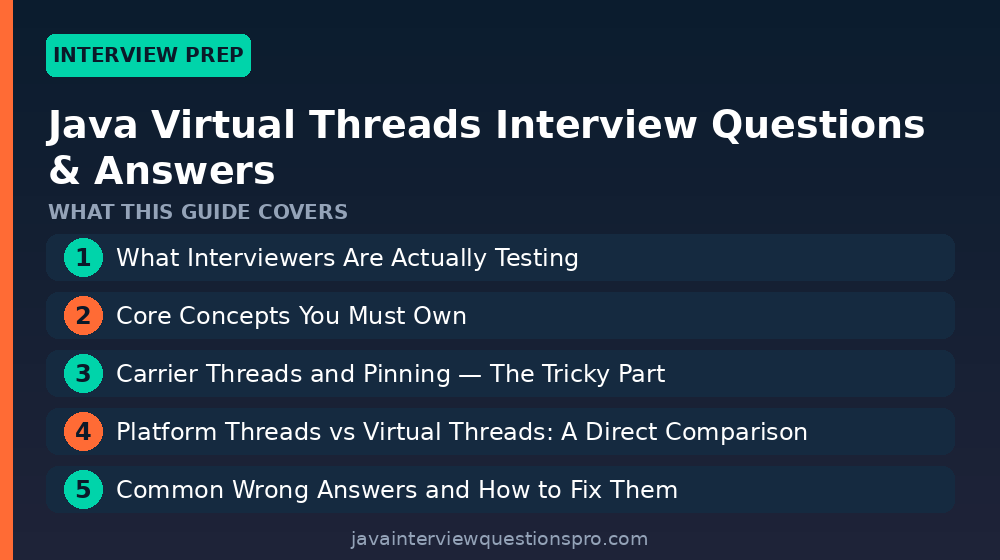
- What Interviewers Are Actually Testing
- Core Concepts You Must Own
- Carrier Threads and Pinning — The Tricky Part
- Platform Threads vs Virtual Threads: A Direct Comparison
- Common Wrong Answers and How to Fix Them
- A Realistic Prep Plan for 2026
- Frequently Asked Questions
What Interviewers Are Actually Testing
Interviewers aren’t quizzing you on API names. They want to know if you understand why virtual threads exist. The real question behind every virtual thread question is: “Do you understand what was wrong with the old model?” If you can articulate that blocking a platform thread is expensive because it ties up an OS thread, and that virtual threads decouple application concurrency from OS resources, you’re already ahead of 70% of candidates.
At TCS and Infosys, expect conceptual questions — definition, use case, how it compares to thread pools. At EPAM and startups, expect deeper follow-ups: pinning, structured concurrency, interaction with synchronized blocks, and whether you’d actually use them in a microservice. Know the concept layer first, then go deeper.
Core Concepts You Must Own
What Is a Virtual Thread?
A virtual thread is a lightweight thread managed by the JVM, not the OS. It’s defined in java.lang.Thread and introduced as a stable feature in Java 21. When a virtual thread blocks (on I/O, a lock, or Thread.sleep()), the JVM unmounts it from the underlying OS thread and parks it in the heap — cheaply. That OS thread (called the carrier thread) is then free to run another virtual thread.
// Creating a virtual thread — Java 21+
Thread vThread = Thread.ofVirtual()
    .name("my-virtual-thread")
    .start(() -> {
        System.out.println("Running on: " + Thread.currentThread());
        // Simulating a blocking I/O call
        try { Thread.sleep(100); } catch (InterruptedException e) { Thread.currentThread().interrupt(); }
    });

vThread.join(); // Wait for it to finish
That’s it. No ExecutorService boilerplate needed for a single thread. Notice Thread.ofVirtual() — that’s the factory method. The JVM schedules this onto a carrier thread from a pool (backed by ForkJoinPool by default), and when sleep() hits, the virtual thread is unmounted. The carrier thread doesn’t block.
Creating Virtual Threads via ExecutorService
In production code, you’ll almost always use an executor. The idiomatic way in Java 21 is:
// Preferred production pattern
try (var executor = Executors.newVirtualThreadPerTaskExecutor()) {
    for (int i = 0; i < 10_000; i++) {
        executor.submit(() -> {
            // Each task gets its own virtual thread — no pool reuse
            fetchFromDatabase(); // blocking I/O — totally fine here
        });
    }
} // Auto-closes and waits for all tasks
The key insight here: newVirtualThreadPerTaskExecutor() creates a new virtual thread per task. Don’t think of it as a pool in the traditional sense — virtual threads are so cheap (a few hundred bytes of stack initially) that creating 10,000 of them is fine. This is a deliberate design choice.
Pro Tip: When an interviewer asks “how many virtual threads can you create?”, the honest answer is: bounded by available heap memory, not OS thread limits. In practice, hundreds of thousands are feasible. But don’t say “unlimited” — that sounds handwavy and imprecise.
Carrier Threads and Pinning — The Tricky Part
This is where most candidates fall flat, and where interviewers at product companies will probe hard. A carrier thread is the platform (OS-backed) thread that a virtual thread runs on. Normally, when a virtual thread blocks, it unmounts from the carrier and the carrier is free. Pinning is when this unmounting cannot happen — the virtual thread gets stuck to its carrier for the duration of the block.
What Causes Pinning?
Two scenarios cause pinning in Java 21:
- The virtual thread executes code inside a
synchronizedblock or method. - The virtual thread calls a native method or a foreign function.
// WARNING: This causes carrier thread pinning
public synchronized void riskyMethod() {
    // If this blocks (e.g., calls a slow DB), the carrier thread
    // is PINNED — it cannot be reused by other virtual threads.
    slowDatabaseCall();
}

// BETTER: Use ReentrantLock instead
private final ReentrantLock lock = new ReentrantLock();

public void safeMethod() throws InterruptedException {
    lock.lock(); // Virtual thread can unmount here if needed
    try {
        slowDatabaseCall();
    } finally {
        lock.unlock();
    }
}
This is a real production concern. If your code uses a JDBC driver that synchronizes internally (many older ones do), you may silently pin carrier threads and negate the scalability benefit of virtual threads. You can diagnose pinning by running with -Djdk.tracePinnedThreads=full as a JVM flag — it logs every pinning event.
The fix is to replace synchronized with java.util.concurrent.locks.ReentrantLock wherever you have potentially blocking operations inside locks. Note: Java 23+ has ongoing work (JEP draft) to reduce pinning in synchronized blocks, but as of Java 21 (the current LTS), this is still a real constraint you must know.
Pro Tip: If an interviewer asks “would you use virtual threads in every Java application?”, say no — they shine in high-concurrency I/O-bound workloads. CPU-bound tasks (heavy computation, image processing) get no benefit, and you might actually hurt throughput by overloading the ForkJoinPool carrier pool.
Platform Threads vs Virtual Threads: A Direct Comparison
| Characteristic | Platform Thread | Virtual Thread |
|---|---|---|
| Managed by | OS scheduler | JVM scheduler |
| Memory per thread | ~1 MB stack (fixed) | ~few hundred bytes (grows on demand) |
| Practical limit | Thousands | Hundreds of thousands |
| Blocking behavior | Blocks OS thread | Unmounts from carrier (usually) |
| Best use case | CPU-bound tasks | I/O-bound, high-concurrency tasks |
| Thread pooling | Recommended (expensive to create) | Not recommended (cheap to create) |
| synchronized pinning | N/A | Yes — known limitation in Java 21 |
One thing candidates miss: virtual threads are still java.lang.Thread instances. They support ThreadLocal, they show up in stack traces, and you can debug them. They’re not coroutines in the Kotlin sense — they’re real threads from the Java API perspective. For deeper concurrency fundamentals, see our Java advanced topics guide.
Common Wrong Answers and How to Fix Them
Mistake 1: “Virtual threads replace thread pools entirely.”
Wrong. For CPU-bound work, a bounded thread pool (sized to CPU cores) is still correct. Virtual threads help when threads spend most of their time waiting — on network, disk, or database I/O. Replace the thread pool with virtual threads only in I/O-heavy scenarios.
Mistake 2: “ThreadLocal is broken with virtual threads.”
Not broken, but dangerous. Because you can create millions of virtual threads, a heavy object stored in ThreadLocal (like a large cache or a connection) gets multiplied across all those threads. The correct approach is to use Scoped Values (JEP 446, preview in Java 21) as a lighter, safer alternative for passing context. Know the difference — interviewers at EPAM will ask this.
Mistake 3: “Virtual threads make your code faster.”
They increase throughput — more concurrent requests with the same hardware — not raw speed. A single request doesn’t complete faster. This distinction matters. See the official JEP 444 specification for the exact design goals.
Mistake 4: Forgetting that virtual threads are non-daemon by default… wait, actually they are daemon threads.
Here’s a real gotcha: virtual threads created with Thread.ofVirtual().start() are daemon threads by default. If your main thread exits, virtual threads get killed. Always use a proper executor or join them. Check the Oracle Thread API documentation for the full spec.
A Realistic Prep Plan for 2026
You don’t need weeks. Here’s a focused approach:
- Days 1-2: Run the code examples in this article on Java 21 locally. Use
jshellfor quick experiments. Enable-Djdk.tracePinnedThreads=fulland intentionally trigger pinning with a synchronized block. - Days 3-4: Read JEP 444 (virtual threads) and JEP 453 (structured concurrency). You don’t need every detail — understand the motivation section and the risks/limitations.
- Days 5-6: Build a tiny Spring Boot 3.2+ app with
spring.threads.virtual.enabled=trueand benchmark it against a traditional thread pool using a mock I/O delay. Seeing the numbers yourself is worth ten articles. Check our Java concurrency basics primer if you need a refresher on locks first. - Day 7: Practice explaining pinning aloud — without notes. If you can explain carrier thread pinning clearly in 90 seconds, you’ll stand out. Also look at LeetCode’s concurrency problems for hands-on coding warm-ups.
Frequently Asked Questions
Are virtual threads available in Java 17 or only Java 21?
Virtual threads were a preview feature in Java 19 (JEP 425) and Java 20 (JEP 436), but became a finalized, production-ready feature only in Java 21 (JEP 444). Java 17 has no virtual thread support at all. If your company is still on Java 17 LTS, you cannot use them without upgrading.
What exactly is a carrier thread and how many are there by default?
A carrier thread is a platform (OS-backed) thread that the JVM uses to execute virtual threads. By default, the JVM creates a ForkJoinPool of carrier threads sized to the number of available CPU cores (Runtime.getRuntime().availableProcessors()). You can override this with -Djdk.virtualThreadScheduler.parallelism=N.
Will synchronized blocks always break virtual thread performance?
Not always — only when the synchronized block contains a blocking operation (I/O, sleep, lock wait). If the critical section is purely CPU-bound and fast, the pinning duration is negligible. The real danger is a synchronized block that calls a slow database or network operation; that pins the carrier thread for the full duration of the wait.
Should I use virtual threads in Spring Boot microservices at my company?
Yes, with conditions. Spring Boot 3.2+ supports virtual threads with a single config property (spring.threads.virtual.enabled=true). It’s practical for REST APIs, database-heavy services, and anything I/O-bound. Avoid them for CPU-intensive batch processing. Also audit your JDBC driver and any library that uses synchronized internally — older Hibernate versions had this issue.
What is the difference between virtual threads and reactive programming (WebFlux)?
Reactive programming (Project Reactor, WebFlux) achieves high concurrency by using non-blocking callbacks and a small event-loop thread pool — but at the cost of complex, hard-to-debug code. Virtual threads achieve similar throughput with blocking, imperative code that’s far easier to read and debug. Oracle’s own documentation acknowledges virtual threads as a simpler alternative to reactive for most I/O-bound workloads.
Can I use virtual threads with JDBC and existing connection pools like HikariCP?
As of Java 21, HikariCP works with virtual threads but you should size the connection pool based on your database’s capacity, not thread count — since you can now create far more virtual threads than connections. There’s also a known pinning risk with older JDBC drivers that use synchronized; check your driver version. HikariCP 5.x has been updated to reduce synchronization-related pinning.