Amazon Java Developer Interview Questions SDE 2026
Here’s a scenario I’ve watched play out more times than I can count: a strong Java developer at TCS or Infosys, four to six years of experience, decides it’s time to aim for Amazon. They spend three months grinding LeetCode, walk into the loop, and get rejected — not because of their DSA, but because they fumbled a behavioral question or couldn’t discuss why HashMap isn’t thread-safe when the interviewer pivoted mid-conversation. Amazon’s SDE interviews are genuinely different. They test three things simultaneously: your coding ability, your system thinking, and whether you’d survive a team standup with an opinionated principal engineer.
⏱️ 9 min read | 📚 Updated June 2026
💡 Quick Tip: Need fast answers? Jump directly to the FAQ section below.
This guide is for Java developers in India preparing for Amazon SDE roles in 2026, whether you’re coming from a service company like Wipro or EPAM, or a funded startup. By the end, you’ll know exactly what each round looks like, which Java concepts trip people up, what the Leadership Principles interviewers are actually probing for, and how to build a six-week prep plan that won’t burn you out.
Table of Contents
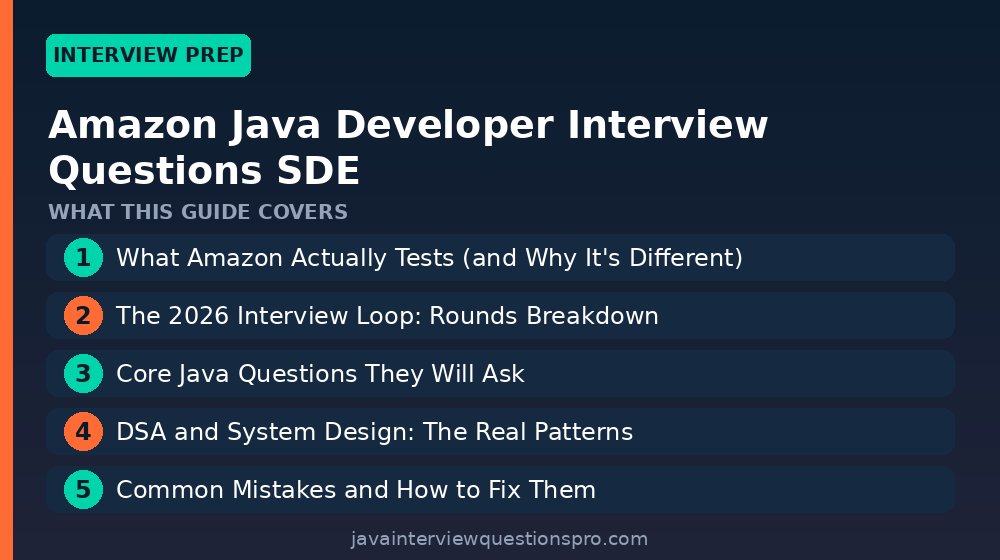
- What Amazon Actually Tests (and Why It’s Different)
- The 2026 Interview Loop: Rounds Breakdown
- Core Java Questions They Will Ask
- DSA and System Design: The Real Patterns
- Common Mistakes and How to Fix Them
- A Realistic 6-Week Prep Plan
- Frequently Asked Questions
What Amazon Actually Tests (and Why It’s Different)
Amazon’s bar-raiser process is real and it’s rigorous. Every loop has a designated bar-raiser — an interviewer from a completely different team whose only job is to decide if you raise the average. They’ve seen hundreds of candidates; vague answers die in that room. The three pillars are non-negotiable: strong coding fundamentals, distributed systems thinking, and demonstrated alignment with Amazon’s Leadership Principles (LPs). Miss any one and you’re out, even if the other two are solid.
Coming from an Indian IT services background, the gap is usually in pillars two and three. You may write clean Java every day, but if you’ve never had to justify a design decision under pressure or narrate a story about disagreeing with a manager, the Amazon loop will expose that. The good news: all three pillars are learnable with the right structure.
The 2026 Interview Loop: Rounds Breakdown
| Round | Duration | Topics Covered | Difficulty |
|---|---|---|---|
| Online Assessment (OA) | 90 min | 2 DSA problems (LeetCode Medium–Hard), 1 work simulation | Medium–Hard |
| Technical Screen | 60 min | 1 DSA problem, Java internals, 1–2 LP questions | Medium |
| On-site Loop (×4) | 55 min each | DSA, system design, LP deep-dives, Java/concurrency | Hard |
| Bar Raiser Round | 55 min | Cross-functional LP + coding or design curveball | Very Hard |
Each on-site round covers both a technical topic and at least one LP question. Don’t expect a “pure system design round” with no behavioral component. That’s not how Amazon works. Budget roughly 15–20 minutes per round for LP storytelling.
Core Java Questions They Will Ask
HashMap Internals and Thread Safety
They’ll hand you a HashMap question and then ask why it isn’t thread-safe. The real answer involves the internal array-of-linked-lists structure and what happens during resize — two threads can create an infinite loop in the bucket chain (a classic Java 7 bug). In Java 8+, the chain converts to a red-black tree at size 8, but concurrent modification during rehashing still corrupts state.
// Wrong: HashMap in a multi-threaded context
Map<String, Integer> map = new HashMap<>();

// Correct option 1: ConcurrentHashMap (segment-level locking in Java 7, CAS + synchronized in Java 8+)
Map<String, Integer> safeMap = new ConcurrentHashMap<>();

// Correct option 2: if you need atomic compute
safeMap.compute("key", (k, v) -> v == null ? 1 : v + 1); // atomic in CHM
The follow-up they always ask: “What’s the difference between ConcurrentHashMap and Collections.synchronizedMap()?” The answer: synchronizedMap locks the entire map for every operation; ConcurrentHashMap uses bucket-level CAS operations in Java 8+, giving far better throughput under concurrent reads.
Java Memory Model and Volatile
For SDE-level roles, expect questions about the Java Memory Model (JMM). They want to know if you understand visibility guarantees versus atomicity. A common wrong answer is “volatile makes operations atomic.” It doesn’t. Volatile guarantees visibility — a write to a volatile variable is immediately visible to other threads — but i++ on a volatile int is still not atomic because it’s read-modify-write.
// WRONG assumption: volatile makes this thread-safe
private volatile int counter = 0;
public void increment() {
    counter++; // NOT atomic — still a race condition
}

// CORRECT: use AtomicInteger
private AtomicInteger counter = new AtomicInteger(0);
public void increment() {
    counter.incrementAndGet(); // CAS-based, truly atomic
}
CompletableFuture in Java 17/21
Amazon’s backend teams use async patterns heavily. Know how CompletableFuture.supplyAsync(), thenCompose() (for dependent futures), and thenCombine() (for independent parallel futures) differ. Be ready to sketch a pipeline: call inventory service and pricing service in parallel, then combine results.
Pro tip: When discussing concurrency at Amazon, always tie your answer to production impact — “under 10k RPS, lock contention here would cause latency spikes.” Interviewers reward candidates who think at scale, not just correctness.
DSA and System Design: The Real Patterns
DSA: What Actually Shows Up
Amazon’s OA and technical screen lean toward graphs (BFS/DFS on implicit graphs), sliding window, and heap-based problems. String manipulation and array problems appear in early rounds; dynamic programming shows up in bar-raiser rounds for senior candidates. The LeetCode problems most commonly reported by Indian candidates in 2024–2025 loops: Number of Islands (BFS), LRU Cache (LinkedHashMap or doubly-linked list + HashMap), Meeting Rooms II (min-heap), and Word Ladder (BFS).
Big-O analysis is mandatory. If you solve a problem in O(n²) and can’t articulate why or propose an O(n log n) improvement, the interviewer will push until you do. Practice explaining complexity out loud — it sounds different than thinking it.
System Design: Think Amazon Scale
Common Amazon system design questions for SDE: design an order management system, design a URL shortener at scale, design a notification service. The framing they want isn’t academic — it’s operational. Which database, why? How do you handle idempotency in a distributed order system? What happens when your message queue consumer dies mid-processing?
A solid answer structure: clarify requirements and constraints → estimate scale (QPS, storage) → high-level diagram with services → deep-dive one component → discuss failure modes. For Java specifically, be ready to discuss Spring Boot microservices, Kafka for async messaging, and Redis for caching — these align with Amazon’s internal patterns.
Pro tip: Amazon interviewers specifically probe for “ownership” in system design. Don’t just describe components — say what you’d monitor, what your SLA would be, and what you’d do at 3am when it breaks. That’s the Ownership LP in action.
Leadership Principles: The Ones That Bite
You need stories for at least 8 of the 16 LPs. The ones that catch candidates off-guard: Have Backbone; Disagree and Commit (they want real conflict, not a “I suggested something politely”), Dive Deep (tell me about a time you found a root cause nobody else found), and Deliver Results (specifics — what were the metrics before and after?). Use the STAR format but make the Result measurable. “We improved performance” is a dead answer. “We reduced p99 latency from 800ms to 120ms by switching from blocking JDBC to R2DBC” is what wins.
Common Mistakes and How to Fix Them
Mistake 1: Jumping into code without clarifying. Amazon interviewers explicitly note whether you asked clarifying questions. Fix: spend 2–3 minutes asking about input size, edge cases, and expected output format before writing a single line.
Mistake 2: Using String concatenation in loops. It’s O(n²) due to immutability. Use StringBuilder. If an interviewer sees this in 2026, they’ll question your Java fundamentals entirely — and rightfully so. See our deeper coverage in Java basics fundamentals.
Mistake 3: Generic LP stories. “I once helped my team deliver a project on time” helps nobody. Amazon’s bar-raisers are trained to probe until you give specifics. Prepare 8–10 stories with actual numbers, actual conflict, actual outcomes.
Mistake 4: Ignoring Java 17/21 features. Records, sealed classes, pattern matching for instanceof — these come up. Knowing that instanceof pattern matching eliminates a cast is a small thing that signals you’re current. Check the official Oracle Java documentation for feature summaries.
Mistake 5: Not knowing your own resume. If you wrote “designed microservices architecture” on your CV, Amazon will ask you to design one on a whiteboard. Every line on your resume is fair game. For deeper prep on advanced Java topics that are fair game, visit Java advanced concepts.
A Realistic 6-Week Prep Plan
Weeks 1–2: DSA fundamentals. Two problems per day from LeetCode’s curated lists — arrays, strings, hashmaps, trees. Time yourself. Write down your Big-O for every solution.
Week 3: Java internals refresh. Concurrency (JMM, volatile, AtomicXxx, ConcurrentHashMap), Collections internals, Streams and CompletableFuture. Write small programs to prove your understanding — don’t just read.
Week 4: System design. Study three systems: URL shortener, rate limiter, notification service. For each, write a one-page design doc. Practice explaining it in 25 minutes out loud.
Week 5: Leadership Principles. Draft 10 STAR stories. Record yourself on your phone. If you can’t explain the conflict and the measurable outcome in under 3 minutes, rewrite. Ask a friend to poke holes.
Week 6: Mock interviews. Two full mock loops (90 minutes each) with peers or a paid platform. Simulate the real thing — camera on, no notes, time-boxed. Debrief ruthlessly.
Frequently Asked Questions
Is Amazon’s SDE interview harder than other FAANG companies for Java developers?
Amazon’s loop is uniquely demanding because it combines DSA, system design, and behavioral assessment in every single round — not in separate rounds. For Java developers from Indian IT services backgrounds, the Leadership Principles component is often the biggest gap, not the coding. Prepare accordingly.
How important is system design for an Amazon SDE (not SDE-II) role?
Even for SDE-1 roles, Amazon expects you to discuss basic distributed system tradeoffs — eventual consistency, message queues, database choice. You won’t be expected to design Google’s search engine, but you should explain why you’d use SQS over a direct API call for async processing.
Do Amazon interviewers care about Spring Boot specifically?
They care about the concepts Spring Boot implements — dependency injection, REST API design, microservices patterns — more than the framework itself. Mentioning Spring Boot is fine and expected, but be ready to explain what’s happening under the hood if they ask.
What Java version knowledge does Amazon expect in 2026?
Know Java 17 well (records, sealed classes, text blocks, pattern matching instanceof) and be aware of Java 21 features (virtual threads via Project Loom, sequenced collections). Virtual threads are particularly relevant for Amazon’s high-throughput services.
How many LeetCode problems should I solve before the Amazon OA?
Quality beats quantity. 100–150 problems solved deeply (understood the optimal solution, analyzed complexity, practiced explanation) is better than 300 problems half-understood. Focus on Medium problems — the OA almost always includes two Mediums and occasionally one Hard.
Can someone from TCS with 5 years of Java experience clear the Amazon loop?
Absolutely yes — several people on my team came from service company backgrounds. The key is bridging the gap in DSA practice and LP storytelling, both of which are learnable. The biggest mistake is underestimating the behavioral component because you’re technically strong.
Three Concrete Next Steps
- Today: Pull up LeetCode, search “Amazon tagged” problems, and solve one medium-level graph problem. Time yourself. Write your Big-O before checking solutions.
- This week: Write three STAR stories — one for Deliver Results, one for Dive Deep, one for Have Backbone; Disagree and Commit. Make each one specific with real numbers.
- This month: Do one full mock system design session (design a rate limiter or notification service) out loud, on a whiteboard or shared screen, with a timer. Talking through design reveals gaps that reading never does.