Java 25 New Features Interview Questions & Examples
⏱️ 10 min read | 📚 Updated June 2026
💡 Quick Tip: Need fast answers? Jump directly to the FAQ section below.
Picture this: you’re sitting across from an EPAM interviewer in Bangalore, and they ask, “So what do you know about Java 25?” Most candidates freeze. They’ve practiced HashMap internals and singleton patterns, but nobody told them Java 25 drops as an LTS release in September 2025 — and interviewers at product companies are already using it as a filter question to separate engineers who stay current from those who coast on Java 8 knowledge.
This guide is for Java developers preparing for roles at TCS, Infosys, Wipro, EPAM, and well-funded startups. It covers the features most likely to come up, explains what the interviewer is actually testing, and gives you working code you can mentally trace through before the interview. Java 25 is still fresh territory — low competition in prep material — which means a solid understanding sets you apart immediately.
By the end, you’ll be able to explain virtual threads, scoped values, compact source files, and finalized pattern matching with the kind of confidence that makes interviewers lean forward.
Table of Contents
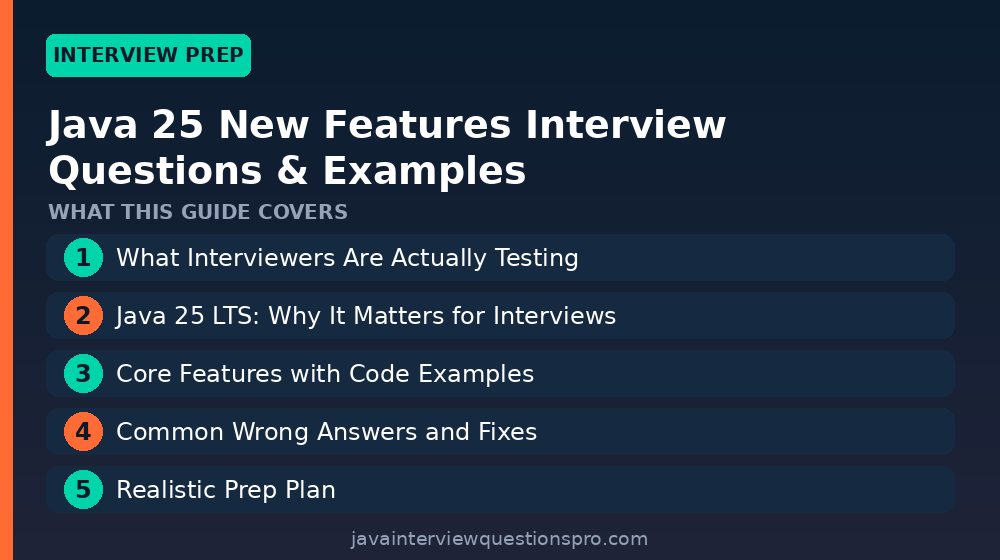
- What Interviewers Are Actually Testing
- Java 25 LTS: Why It Matters for Interviews
- Core Features with Code Examples
- Common Wrong Answers and Fixes
- Realistic Prep Plan
- Frequently Asked Questions
What Interviewers Are Actually Testing
When a senior engineer asks about Java 25 features, they’re rarely drilling you on syntax. They want to know three things: do you understand why a feature was added, can you explain a real problem it solves, and do you know the tradeoffs. Saying “virtual threads are lightweight threads” earns a nod. Saying “virtual threads let you write blocking I/O code that scales like reactive, without callback hell — useful in microservices where thread-per-request model breaks at scale” earns the next round.
At TCS and Infosys, expect conceptual questions with “compare old vs new” framing. At EPAM and startups, expect “write me a quick example” or “where would you use this in a Spring Boot service?” The table below maps the interview style to what you need to prepare.
| Company Type | Question Style | Depth Expected | Java 25 Topics Likely |
|---|---|---|---|
| TCS / Infosys / Wipro | Conceptual, compare-and-contrast | Moderate — know the why | Virtual threads, pattern matching basics |
| EPAM / Thoughtworks | Code-and-explain, design tradeoffs | High — production context expected | Scoped values, structured concurrency |
| Funded Startups | Practical — “would you use this here?” | High — migration and risk awareness | Compact source files, all features |
Java 25 LTS: Why It Matters for Interviews
Java 25 is scheduled as an LTS release in September 2025, making it the successor to Java 21 in terms of enterprise adoption. That LTS tag matters — companies don’t upgrade on every release, but they do upgrade on LTS. Interviewers at companies planning a Java 21 → 25 migration are specifically looking for engineers who’ve already thought about what changes.
Several features that were previews in Java 21-23 graduate to finalized status in Java 25. This graduation is itself interview gold. If an interviewer asks “what’s different about scoped values in Java 25 vs Java 21?” and you can say “it moved from preview to standard API, so you no longer need --enable-preview and the API is now stable for production use,” you’ve demonstrated exactly the kind of version-awareness senior engineers expect.
Pro tip: Java 25 finalizes features that were previews across Java 21–24. Knowing which features “graduated” — and what that means for production code — is a genuinely differentiating answer in interviews.
Core Features with Code Examples
1. Virtual Threads (Finalized — Project Loom)
Virtual threads were introduced in Java 21 and are fully production-ready by Java 25 with several refinements. The core idea: instead of one OS thread per Java thread (expensive, limits you to thousands), virtual threads are cheap JVM-managed threads you can spin up in millions. This is massive for REST APIs and database-heavy microservices.
The interviewer follow-up after you explain this: “But won’t you get thread pinning issues?” Yes — if you use synchronized blocks, a virtual thread can pin to a carrier OS thread. The fix is to use ReentrantLock instead. Know this cold.
import java.util.concurrent.Executors;

public class VirtualThreadDemo {
    public static void main(String[] args) throws InterruptedException {
        // Creates a thread-per-task executor using virtual threads
        try (var executor = Executors.newVirtualThreadPerTaskExecutor()) {
            for (int i = 0; i < 10_000; i++) {
                int taskId = i;
                executor.submit(() -> {
                    // Simulates blocking I/O — fine on virtual threads
                    Thread.sleep(100);
                    System.out.println("Task " + taskId + " on: " + Thread.currentThread());
                    return null;
                });
            }
        } // executor.close() blocks until all tasks finish
    }
}
Ten thousand tasks, each sleeping 100ms — on platform threads this would exhaust your thread pool. On virtual threads, the JVM parks them during the sleep and reuses carrier threads. This is what “blocking I/O that scales like reactive” means in practice.
2. Scoped Values (Finalized)
Scoped values solve a specific, real problem: sharing immutable data across a call chain within a thread (or a tree of virtual threads) without passing parameters everywhere. Think of it as ThreadLocal‘s more principled sibling — but it’s not just a rename. ThreadLocal is mutable, leaks if you forget to remove, and doesn’t compose well with virtual threads. Scoped values are immutable and are automatically cleaned up when the scope ends.
import jdk.incubator.concurrent.ScopedValue; // standard in Java 25

public class ScopedValueDemo {
    // Declare a scoped value — like a typed "key"
    static final ScopedValue USER_ID = ScopedValue.newInstance();

    public static void main(String[] args) {
        ScopedValue.where(USER_ID, "user-42").run(() -> {
            processRequest(); // USER_ID is visible anywhere in this scope
        });
        // USER_ID is unbound here — no cleanup needed
    }

    static void processRequest() {
        // No parameter passing needed; reads from the current scope
        System.out.println("Processing for: " + USER_ID.get());
        auditLog();
    }

    static void auditLog() {
        System.out.println("Audit: " + USER_ID.get()); // Still accessible
    }
}
Interviewers love this question at EPAM-style shops because it tests whether you understand thread-safety at a conceptual level, not just syntax. The follow-up: “How is this different from passing a parameter?” Answer: scoped values propagate automatically into child virtual threads via structured concurrency, which parameters can’t do without explicit wiring.
3. Compact Source Files (Preview — Simpler Java Programs)
This one surprises candidates. Java 25 introduces the ability to write a simple Java program without wrapping it in a class declaration. No public class, no boilerplate — just write your method and run it with java Hello.java. It’s squarely aimed at scripting use cases and reducing Java’s learning-curve friction.
// File: Hello.java — valid in Java 25 with compact source files
void main() {
    String name = "Priya";
    System.out.println("Hello, " + name + "!");
    greet(name);
}

void greet(String name) {
    System.out.println("Welcome to Java 25, " + name);
}
Run it with java Hello.java — no compilation step, no class wrapper. Interviewers won’t ask you to code this (it’s preview), but they will ask: “What problem does this solve?” Wrong answer: “It makes Java like Python.” Correct answer: “It lowers the barrier to entry for scripting and tooling tasks without changing the language semantics — the compiler still handles it the same way underneath.”
4. Pattern Matching — instanceof and Switch (Finalized)
Pattern matching for switch — which had a long preview journey starting in Java 17 — is fully finalized and stable in Java 25. This is high-probability interview material across all company types because it changes how you write type-safe branching logic.
// Pattern matching switch — finalized in Java 25
sealed interface Shape permits Circle, Rectangle, Triangle {}
record Circle(double radius) implements Shape {}
record Rectangle(double w, double h) implements Shape {}
record Triangle(double base, double height) implements Shape {}

public class PatternDemo {
    static double area(Shape shape) {
        return switch (shape) {
            case Circle c    -> Math.PI * c.radius() * c.radius();
            case Rectangle r -> r.w() * r.h();
            case Triangle t  -> 0.5 * t.base() * t.height();
            // No default needed — compiler knows Shape is sealed/exhaustive
        };
    }
}
The sealed interface + pattern switch combination is what the interviewer is really testing. With a sealed hierarchy, the compiler enforces exhaustiveness — you can’t forget a case. That’s the production value: safer refactoring when you add a new subtype, because the compiler flags every switch that’s now non-exhaustive.
Common Wrong Answers and Fixes
Mistake 1: “Virtual threads replace thread pools entirely.” Wrong. CPU-bound tasks still benefit from a bounded pool sized to core count. Virtual threads shine for I/O-bound, blocking work. Using them for heavy computation creates overhead without benefit.
Mistake 2: “Scoped values are just a better ThreadLocal.” Partially true but incomplete. The key difference: ThreadLocal is mutable and per-thread; scoped values are immutable and propagate into structured concurrency child tasks. If you only say “better ThreadLocal,” the interviewer will probe with “what about child threads?” and you’ll be stuck.
Mistake 3: Saying compact source files are “production-ready.” They’re in preview in Java 25. Preview means the feature could still change. Never recommend a preview feature for production code — say it’s great for tooling and prototyping while it stabilizes.
Pro tip: When an interviewer asks about any Java feature, answer in this structure: “The problem it solves → the old way → the new way → the tradeoff.” Four sentences. You’ll never sound confused.
Realistic Prep Plan
You have two weeks before your interview. Here’s what to actually do, in priority order.
Week 1 — Understand, don’t memorize. Set up a Java 25 early-access build from jdk.java.net and run the virtual thread and pattern matching examples yourself. Reading code is not the same as running it. Focus on virtual threads and scoped values — they’re the highest-signal topics at product companies.
Week 2 — Practice explaining. Open your IDE, write each feature from scratch without looking, then explain it out loud to yourself or a friend. For EPAM-level interviews, also review the official Thread API docs for structured concurrency context. Link new features back to your project experience — “I would have used scoped values in the request-tracing layer of my last microservice” lands better than a textbook definition.
Pair this with a solid review of Java advanced concepts like the memory model and concurrency utilities, since interviewers rarely ask about new features in isolation — they test whether you can connect them to fundamentals. If you’re starting from basics, our Java basics guide has the foundation covered.
Frequently Asked Questions
Is Java 25 already released, and should I mention it in interviews now?
Java 25 is scheduled for GA release in September 2025 as an LTS version. You can and should mention it in interviews happening around or after that date — interviewers at product companies reward candidates who demonstrate awareness of the release roadmap. If you’re interviewing before GA, frame it as “Java 25, releasing as LTS in September 2025, finalizes these features.”
What’s the single most important Java 25 feature to know for interviews?
Virtual threads, without question. They directly impact how you design REST APIs and microservices, which is the daily reality for most Java engineers. Understanding thread pinning, when NOT to use virtual threads (CPU-bound tasks), and the difference from reactive programming shows genuine production thinking.
How is Java 25 different from Java 21 if both are LTS releases?
Java 21 was the first LTS with virtual threads and pattern matching in various preview/finalized states. Java 25 graduates several features that were still in preview — scoped values, structured concurrency, and compact source files move closer to or reach finalization. For enterprises, Java 25 is the next planned migration target after Java 21, which is why interviewers are already screening for awareness of it.
Will TCS and Infosys actually ask Java 25 questions in 2025?
For experienced hire roles (3+ years), yes — especially if the job description mentions Java 17+ or “latest Java features.” For fresher interviews, you’re more likely to see Java 8–11 fundamentals. That said, mentioning Java 25 awareness proactively in any interview signals that you’re a developer who keeps current, which is always a positive signal.
What’s the difference between scoped values and ThreadLocal, in one clear sentence?
ThreadLocal is mutable, requires manual cleanup, and doesn’t propagate to child threads in structured concurrency; ScopedValue is immutable, cleans up automatically when the scope ends, and propagates into structured concurrency child tasks — making it far safer in high-concurrency virtual thread environments.
Do I need to know about structured concurrency separately from virtual threads?
Yes — they’re related but distinct. Virtual threads are the mechanism (lightweight threads); structured concurrency (the StructuredTaskScope API) is the discipline for managing their lifecycle so that tasks don’t leak and errors propagate cleanly. An EPAM or startup interviewer will almost certainly ask about both together, so study them as a pair.