Capgemini Java Developer Interview Questions 2026
You’ve got a Capgemini interview scheduled and you’re staring at a list of 200 “top questions” that all look the same. Here’s the uncomfortable truth — most of those lists are recycled fluff. What actually happens in a Capgemini Java developer interview is more structured than people expect, and once you understand the pattern, it becomes very manageable.
This guide is for Java developers with 1–5 years of experience targeting Capgemini’s software engineering or associate consultant roles. Whether you’re coming from TCS, Infosys, or a mid-size product company, the concepts tested here overlap heavily — so this prep will serve you at Wipro, EPAM, and even early-stage startups that run similar process-heavy loops.
⏱️ 9 min read | 📚 Updated June 2026
💡 Quick Tip: Need fast answers? Jump directly to the FAQ section below.
By the end of this post, you’ll know exactly which Java topics Capgemini focuses on, what interviewers are actually evaluating in each round, and the mistakes that kill otherwise good candidates’ chances.
Table of Contents
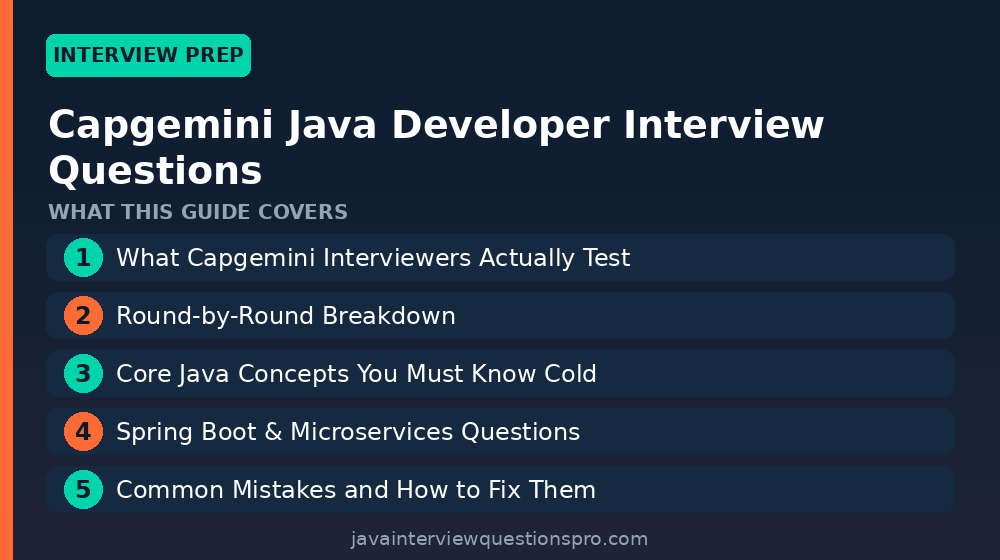
- What Capgemini Interviewers Actually Test
- Round-by-Round Breakdown
- Core Java Concepts You Must Know Cold
- Spring Boot & Microservices Questions
- Common Mistakes and How to Fix Them
- A Realistic 2-Week Prep Plan
- Frequently Asked Questions
What Capgemini Interviewers Actually Test
Capgemini runs a lot of client-facing delivery work, which means your interviewer cares about two things equally: can you write correct code, and can you explain your decisions to a non-technical stakeholder? That second part surprises a lot of people. You’ll get asked “why did you choose this approach?” more often than at a pure product company.
The technical bar at Capgemini sits roughly between a service company (TCS/Infosys) and a mid-tier product firm. Don’t show up expecting LeetCode hard problems — but don’t expect zero coding either. Expect solid OOP, Collections internals, Spring Boot basics, and SQL, with a 30-minute coding exercise that’s closer to LeetCode easy-medium.
Pro tip: Capgemini interviewers frequently pivot from a concept question to “how have you used this in production?” Prepare one real project story for each major topic — Collections, multithreading, and REST APIs — before you walk in.
Round-by-Round Breakdown
| Round | Format | Key Topics | Difficulty |
|---|---|---|---|
| R1 — Online Assessment | MCQ + 1-2 coding problems (90 min) | Core Java, OOP, basic DS&A, SQL | Easy–Medium |
| R2 — Technical Interview 1 | Video/in-person (45–60 min) | Java internals, Collections, Exceptions, JDBC | Medium |
| R3 — Technical Interview 2 | Video/in-person (45–60 min) | Spring Boot, Microservices, REST, Multithreading | Medium–Hard |
| R4 — Managerial / HR | Structured conversation (30 min) | Project deep-dive, communication, fitment | Soft skills |
Core Java Concepts You Must Know Cold
HashMap Internals — The Question Behind the Question
They’ll hand you a HashMap question and then ask why it isn’t thread-safe. Almost every Capgemini technical round I’ve heard about touches HashMap. Know that before Java 8, collisions created a linked list at a bucket; from Java 8 onwards, a bucket converts to a red-black tree when it has more than 8 entries (treeification). That detail alone separates you from 80% of candidates.
// Common question: What happens here under concurrent access?
Map<String, Integer> map = new HashMap<>();

// Thread 1 and Thread 2 both calling put() simultaneously
// can cause infinite loops (pre-Java 8) or data loss.
// Fix: use ConcurrentHashMap for thread safety
Map<String, Integer> safeMap = new ConcurrentHashMap<>();
safeMap.put("score", 100);
The follow-up is always: “What’s the difference between ConcurrentHashMap and Hashtable?” Answer: Hashtable locks the entire map on every operation. ConcurrentHashMap uses segment-level (Java 7) or CAS-based (Java 8+) locking, so reads are almost never blocked. In production, Hashtable is essentially dead — never use it in new code.
String Pool and Immutability
String immutability is a classic because it underpins thread safety, HashMap key reliability, and security. Be ready to explain why String is final — it’s not just convention, it prevents subclassing that could break the contract of immutability.
String a = "hello";       // goes into String pool (heap)
String b = "hello";       // same reference from pool
String c = new String("hello"); // new object on heap, NOT pool

System.out.println(a == b);      // true  — same pool reference
System.out.println(a == c);      // false — different object
System.out.println(a.equals(c)); // true  — same content
The wrong answer candidates give: “I always use .equals() so it doesn’t matter.” That’s fine for correctness, but it misses the interviewer’s point. They want to know you understand why the pool exists — it’s a JVM memory optimization that works precisely because Strings are immutable and can be safely shared.
Functional Interfaces and Streams (Java 8+)
Capgemini projects heavily use Java 8–17 features. A typical question: filter a list of employees by department and return a sorted list of names. Know the difference between map() and flatMap() — that’s the follow-up they always ask.
List<String> names = employees.stream()
    .filter(e -> "Engineering".equals(e.getDepartment()))
    .sorted(Comparator.comparing(Employee::getName))
    .map(Employee::getName)
    .collect(Collectors.toList());
// flatMap() is used when each element maps to a Stream,
// e.g., flattening List<List<String>> into List<String>
Also review Optional — interviewers ask how it prevents NullPointerException and when it’s inappropriate to use it (don’t use it as a method parameter type; Oracle’s own advice is it’s for return types only).
Spring Boot & Microservices Questions
Round 3 almost always has Spring Boot. The most common opening question is deceptively simple: “What happens when a Spring Boot application starts?” Walk through @SpringBootApplication as a composite of @Configuration, @EnableAutoConfiguration, and @ComponentScan. Explain that auto-configuration uses spring.factories (or AutoConfiguration.imports in Spring Boot 3.x) to conditionally load beans.
For microservices, expect questions on service discovery (Eureka), API gateways (Spring Cloud Gateway), and inter-service communication (RestTemplate vs. WebClient vs. Feign). The real question behind “what is a circuit breaker?” is whether you’ve dealt with cascading failures — mention Resilience4j by name, and explain that a circuit breaker moves to OPEN state after a threshold of failures, then tries a HALF-OPEN probe before recovering.
Pro tip: When asked about microservices, tie your answer to a specific problem you solved — “We had a payment service that caused our order service to timeout under load, so we added a Resilience4j circuit breaker with a 50% failure threshold.” One concrete sentence like that is worth more than two minutes of theory.
For Spring Boot REST APIs, know @RestController vs @Controller, how @ExceptionHandler and @ControllerAdvice work for global error handling, and the difference between @RequestParam and @PathVariable. These are genuinely asked, not just listed as “possible” questions.
Check the official Spring Boot reference documentation for auto-configuration internals — reading even the first chapter puts you ahead of most candidates.
Common Mistakes and How to Fix Them
Mistake 1: Memorizing answers without understanding tradeoffs. Interviewers at Capgemini probe with “why” and “when would you not use this?” If you say “use StringBuilder instead of String concatenation in loops,” they’ll ask when it doesn’t matter. Answer: for fewer than ~5 concatenations or compile-time constants, the JVM and javac optimise it anyway — StringBuilder only pays off in loops with many iterations.
Mistake 2: Ignoring checked vs. unchecked exception strategy. A surprisingly common stumble — candidates know the definition but can’t explain when to use each. Checked exceptions are for recoverable conditions (file not found — maybe try a fallback path). Unchecked (RuntimeException) are for programming errors (null pointer, illegal argument). In Spring, most exceptions are unchecked intentionally so they bubble up to a @ControllerAdvice.
Mistake 3: Writing uncompilable code on the whiteboard. In the online assessment, forgetting to handle IOException in a try-catch or using == on Strings costs you marks even when your logic is right. Practice on LeetCode’s easy string problems to build muscle memory for clean Java syntax under pressure.
Mistake 4: Vague answers on multithreading. “I know about synchronized and volatile” is not enough. Know that volatile guarantees visibility but NOT atomicity — volatile int count++ is still a race condition because it’s a read-modify-write. Use AtomicInteger or synchronized for that. See our deep-dive on Java advanced concurrency topics if this area feels shaky.
A Realistic 2-Week Prep Plan
Two weeks is enough if you’re focused. Here’s how to split it:
- Days 1–3: Core Java — Collections internals (HashMap, LinkedHashMap, TreeMap), String pool, Generics wildcards, Exception hierarchy. Do 3 LeetCode easy problems daily.
- Days 4–6: Java 8–17 — Streams, Optional, functional interfaces, records (Java 16+), sealed classes (Java 17). Write actual code, don’t just read.
- Days 7–9: Multithreading — synchronized, volatile, AtomicInteger, ExecutorService, CompletableFuture basics. Understand the Java Memory Model at a conceptual level.
- Days 10–12: Spring Boot — dependency injection, REST APIs, Spring Data JPA basics, transaction management (
@Transactionalpropagation levels are asked more than you’d expect). - Days 13–14: Mock interviews. Practice answering out loud — your brain knows the answer but your mouth needs reps. Record yourself once; it’s uncomfortable but effective.
For the coding round specifically, focus on arrays, strings, HashMaps, and basic recursion. Capgemini doesn’t test dynamic programming in most rounds, but two-pointer and sliding window patterns do appear. Brush up on our Java basics fundamentals guide if you need to solidify your foundation before tackling advanced topics.
Also review the Java 17 API documentation for any class you plan to mention — knowing the exact method signature builds confidence and shows genuine familiarity.
Frequently Asked Questions
Is Capgemini’s Java interview harder than TCS or Infosys?
Slightly harder on average, especially at the 3–5 year experience band. TCS and Infosys tend to focus more on theoretical definitions; Capgemini will ask you to write code and explain your production decisions. That said, it’s still more structured and predictable than a product company like a startup or EPAM.
Do they ask DSA or competitive programming questions?
Occasionally in the online assessment, but nothing beyond LeetCode easy-medium. Expect problems on array manipulation, string reversal, finding duplicates with a HashMap, or basic linked list operations. Full dynamic programming is rare for Java developer roles — it’s more common if you’re applying for an analyst or algorithm-heavy position.
What Java version does Capgemini expect you to know?
Practically speaking, Java 8 features are non-negotiable. Most interviewers also expect familiarity with Java 11 and Java 17 LTS features — records, text blocks, sealed classes, and the newer Stream API additions. Mentioning Java 21 virtual threads (Project Loom) is a bonus that impresses interviewers but won’t hurt you if you don’t know it deeply.
Will they ask about databases and SQL in a Java interview?
Yes, almost always in Round 2. Expect basic to intermediate SQL — JOINs, GROUP BY, subqueries, and index concepts. On the JPA side, know the difference between EAGER and LAZY loading and why N+1 query is a problem. These come up because Capgemini projects are typically full-stack Java with a relational database backend.
How important is the HR/Managerial round at Capgemini?
More important than at most companies. Capgemini is a client-facing delivery organisation, so the managerial round genuinely evaluates whether they can put you in front of a client. Prepare specific STAR-format answers for conflict resolution, handling tight deadlines, and a time you proactively improved a process. Don’t treat it as a formality.
Should I prepare microservices design questions or just Spring Boot basics?
Both, but calibrate by experience level. For 1–3 years: focus on Spring Boot REST, JPA, and basic Spring Security. For 3–5 years: expect microservices patterns — service discovery, circuit breakers, distributed tracing (Zipkin/Sleuth), and messaging (Kafka basics). The more senior the role, the more they’ll push on system design over individual code correctness.