EPAM Java Developer Interview Questions 2026
⏱️ 9 min read | 📚 Updated June 2026
💡 Quick Tip: Need fast answers? Jump directly to the FAQ section below.
This post is for Java developers — 2 to 8 years of experience — who want a realistic picture of what EPAM’s 2026 interview process looks like. I’ll walk you through every round, the specific questions that trip people up, real code examples, and the mistakes I’ve watched candidates make from the interviewer’s side of the table.
By the end, you’ll know exactly what to prepare, what to skip, and how to answer follow-ups confidently instead of going blank the moment the interviewer digs deeper.
Table of Contents
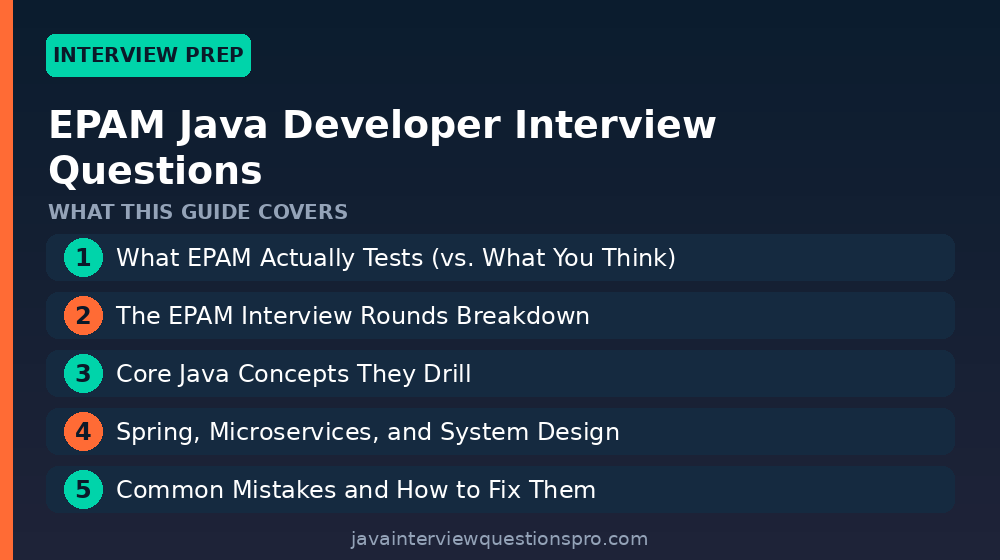
- What EPAM Actually Tests (vs. What You Think)
- The EPAM Interview Rounds Breakdown
- Core Java Concepts They Drill
- Spring, Microservices, and System Design
- Common Mistakes and How to Fix Them
- A Realistic 4-Week Prep Plan
- Frequently Asked Questions
What EPAM Actually Tests (vs. What You Think)
Most candidates walk in prepared to recite definitions. EPAM interviewers — many of them senior engineers on active client projects — want to see reasoning. The favourite trick is starting with a textbook question and then immediately going sideways. They’ll ask you about HashMap and then follow up with “why isn’t it thread-safe, and what exactly breaks under concurrent writes?” That second question is where your preparation is tested.
EPAM also cares about production context. If you say “use ConcurrentHashMap,” the follow-up is “what’s the internal locking strategy in Java 8 onwards, and how does it differ from Hashtable?” They want engineers who’ve debugged things in production, not just read about them the night before.
One more honest note: coding rounds at EPAM are LeetCode-style but not LeetCode-hard. Medium-difficulty problems with an emphasis on clean code and explaining your reasoning. They’re not trying to make you feel stupid — they’re testing whether you can communicate solutions like a professional.
The EPAM Interview Rounds Breakdown
| Round | Duration | Topics Covered | Difficulty |
|---|---|---|---|
| HR / Screening Call | 20–30 min | Experience, notice period, basic Java awareness | Low |
| Technical Round 1 | 60–75 min | Core Java, OOP, Collections, Multithreading | Medium |
| Technical Round 2 | 60–90 min | Spring Boot, Microservices, REST, DB/JPA, Coding problem | Medium–High |
| System Design / Architecture | 45–60 min | Design patterns, scalability, real-world tradeoffs | High (for 5+ yrs) |
| Final HR / Client Fit | 30 min | Communication, project fit, salary | Low |
Candidates with under 3 years of experience sometimes skip the system design round. Don’t count on it — prepare anyway. EPAM’s clients are often European or American product companies, so the “client fit” round tests whether you can communicate technically in English clearly and confidently.
Core Java Concepts They Drill
Memory Model and the String Pool
A surprisingly common question: “What’s the difference between new String("hello") and "hello"?” Sounds basic. The follow-up never is. They want you to explain the String pool in the heap (moved out of PermGen since Java 8), intern(), and why String immutability matters for HashMap keys.
String s1 = "hello";           // goes to String pool
String s2 = new String("hello"); // new object in heap
String s3 = s2.intern();       // returns the pooled reference

System.out.println(s1 == s2);  // false — different references
System.out.println(s1 == s3);  // true  — same pool reference
System.out.println(s1.equals(s2)); // true — same content
The common wrong answer is confidently saying s1 == s2 is true. It’s not — == compares references, not values. An interviewer who hears that mistake will immediately probe deeper into equals() vs hashCode() contracts, so get this right upfront.
Multithreading: The Real Questions
EPAM loves threading questions because that’s where surface-level knowledge collapses. Expect questions on volatile, synchronized, the Java Memory Model visibility guarantees, and the ExecutorService lifecycle. In 2025–2026 interviews, Virtual Threads (Java 21, Project Loom) are starting to appear too.
// Common trap: is this counter thread-safe?
class Counter {
    private int count = 0;

    public void increment() {
        count++; // NOT atomic: read-modify-write, 3 operations
    }
}

// Fix 1: AtomicInteger
private AtomicInteger count = new AtomicInteger(0);
public void increment() { count.incrementAndGet(); }

// Fix 2: synchronized (coarser, but sometimes needed)
public synchronized void increment() { count++; }
count++ is the classic trap. It looks like one operation but it’s three: read, increment, write. Under concurrent access, two threads can read the same value and both write back, losing an update. AtomicInteger uses CAS (Compare-And-Swap) at the CPU level — that’s what EPAM wants you to say.
Pro tip: When you mention
volatile, also mention what it does NOT guarantee — it ensures visibility across threads but not atomicity. A volatile int counter is still not safe forcount++. EPAM interviewers specifically listen for this nuance.
Collections Internals
Know your HashMap internals cold: initial capacity 16, load factor 0.75, resize doubles the array, Java 8+ converts buckets to balanced trees (red-black) when a bucket exceeds 8 entries. The follow-up after this is usually “what’s the time complexity of get()?” — O(1) average, O(log n) worst-case in Java 8+ (not O(n) anymore due to tree buckets). That distinction matters and most candidates get it wrong.
Spring, Microservices, and System Design
Spring Boot Questions That Go Beyond Basics
Don’t just know that @Transactional exists — know when it breaks. A very common EPAM question: “Why does @Transactional not work when you call a method within the same class?” The answer involves Spring AOP proxies. When you call this.someMethod(), you bypass the proxy entirely, so the transaction never starts. The fix is either restructuring the code or injecting the bean into itself (ugly but sometimes necessary before Spring 6).
Microservices Tradeoffs
For the system design round, EPAM cares about tradeoffs, not textbook definitions. If you say “use Kafka for async communication,” they’ll ask “what happens when a consumer is down for 2 hours — how do you handle message backlog and ordering?” Think about retention policies, consumer group offsets, and partition strategies. These are real production concerns on the client projects you’d be placed on.
| Communication Style | Use When | Key Risk | Java Libraries |
|---|---|---|---|
| REST (synchronous) | Real-time response needed | Cascading failures | Spring WebClient, Feign |
| Kafka (async) | Event-driven, high throughput | Message ordering, duplicates | spring-kafka |
| gRPC | Internal services, low latency | Schema coupling | grpc-java |
Common Mistakes and How to Fix Them
Mistake 1: Memorizing without understanding. Candidates recite “HashMap uses chaining for collision resolution” but can’t explain what happens during resize or why hashCode() quality matters for performance. Fix: implement a tiny HashMap yourself in practice — 50 lines teaches you more than 10 articles.
Mistake 2: Ignoring Java 17/21 features. EPAM projects often run on recent LTS versions. If you’ve been coding against Java 8 mentally, study Records, Sealed Classes, Pattern Matching for instanceof, and Virtual Threads. An interviewer asking “how would you simplify this DTO with modern Java?” expects you to say Records, not Lombok.
Mistake 3: Treating the coding round as a solo exercise. EPAM interviewers watch your thought process. Saying “I’ll start with a brute force O(n²) and then optimise” scores much higher than silently producing a perfect solution. Talk while you code. If you go quiet for 5 minutes, that’s a red flag to them regardless of whether your code is correct.
Pro tip: Before every technical answer, take one breath and frame your answer: “There are two aspects here — the what and the why.” It slows you down just enough to give a structured answer instead of a word-salad panic response. EPAM interviewers specifically appreciate structured communicators because you’ll be working with international clients.
A Realistic 4-Week Prep Plan
Week 1 — Java Core Depth: Spend this week on memory model, threading (volatile, synchronized, AtomicXxx, ExecutorService), and Collections internals. Read the Java 21 Memory Model spec (Chapter 17, JLS) — even skimming it tells you more than most prep guides. Pair it with our Java advanced concepts guide for threading deep-dives.
Week 2 — Spring & JPA: Focus on Spring Boot internals — bean lifecycle, AOP proxies, transactional pitfalls. JPA: N+1 problem, fetch types, entity state lifecycle (transient → managed → detached → removed). These are near-guaranteed questions at EPAM.
Week 3 — Microservices & System Design: Design a URL shortener, a rate limiter, and a notification service. For each: data model, API contract, failure handling. Review CAP theorem in the context of real choices — “I’d use Cassandra here because it’s AP and we can tolerate eventual consistency for this use case” is the kind of answer EPAM wants.
Week 4 — Coding Problems + Mock Interviews: Solve 15–20 Medium problems on LeetCode (Arrays, Hash Tables, Trees). Focus on HashMap, two-pointer, and tree traversal patterns. Do at least 2 mock interviews with a peer — verbalising answers out loud is a different skill than writing them down. Also revisit our core Java basics checklist to plug any gaps.
Frequently Asked Questions
Is EPAM’s Java interview harder than TCS or Infosys?
Yes, meaningfully harder. TCS and Infosys interviews at the fresher-to-mid level focus heavily on definitions and pattern matching. EPAM pushes on the “why” and “what breaks in production” angle, and their coding round is a genuine test of problem-solving rather than a formality.
Does EPAM ask DSA or LeetCode-style questions?
Yes, usually one coding problem per technical round — Medium difficulty, focusing on arrays, hashmaps, trees, and occasionally graphs. They care more about your reasoning and code quality than raw speed, so explaining your approach out loud matters.
What Java version should I prepare for EPAM interviews in 2026?
Prepare with Java 21 as your baseline (the current LTS). Know Java 8 features cold (Streams, Lambdas, Optional), but also be comfortable with Java 17 Sealed Classes, Records, and Java 21 Virtual Threads — they’re appearing in interviews now.
How long does the EPAM hiring process take in India?
Typically 2–4 weeks from first contact to offer. If you’re being placed on a specific client project, there may be an additional client interview round, which can extend the timeline by another 1–2 weeks.
What if I fail the EPAM technical round — can I reapply?
Generally yes, after a 6-month cooldown period. EPAM keeps interview feedback on file, so if you reapply, come back with concrete improvements — new project experience, open-source contributions, or a certification won’t hurt.
Do I need to know Kubernetes or cloud (AWS/Azure) for EPAM Java roles?
It depends on the role level. For mid-level (3–5 years), knowing Docker basics and Spring Cloud Config/Eureka is sufficient. Senior roles increasingly expect real Kubernetes experience — deployments, services, and basic Helm. AWS or Azure familiarity is a strong plus but rarely a hard requirement at interview stage.