Top Core Java Interview Questions for 10 Years Experience (with Expert Answers)
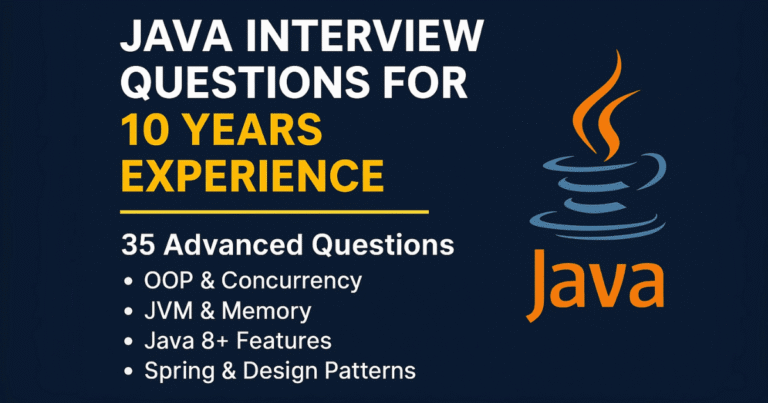
In 2025, if you’re preparing for a senior Java developer interview, the most commonly asked core Java interview questions for 10 years experience is here, with real-world answers that show depth, system thinking and production-grade skills. This answers will also help you to showcase your indpeth knowledge in java.

Below are not just questions, but expert-style answers you can use to prepare, copy, and paste — or simply understand the mindset of an experienced Java professional.
1. What are the internal workings of HashMap?
Answer:
HashMap stores data in an array of
Node<K, V>. Each node holds a key, value, hash, and next pointer. Hash is calculated usinghashCode()and then improved with(h >>> 16) ^ h. On collision, it uses chaining. Since Java 8, buckets with >8 nodes convert to balanced trees (Red-Black Tree) to optimize lookup. I once diagnosed a bug where poorequals()implementation caused incorrect retrievals in production.
2. HashMap vs Hashtable vs ConcurrentHashMap
Answer:
HashMap is not thread-safe. Hashtable is synchronized but has poor scalability due to coarse locking. ConcurrentHashMap uses finer-grained locking (bucket-level or segment-level) and supports high concurrency. I used ConcurrentHashMap to cache service data in multi-threaded services.
3. Why is String immutable and final?
Answer:
Immutability ensures thread-safety, caching, and consistent hash codes. String is
finalto prevent overriding behavior that could break core Java functionality like class loading and security. It also allows safe sharing via the String pool.
4. Checked vs Unchecked Exceptions
Answer:
Checked exceptions are for recoverable issues (e.g. FileNotFound), unchecked for programming errors (e.g. NullPointerException). I use checked exceptions for business logic and unchecked for infrastructure-level failures.
5. Java Memory Model & GC
Answer:
JVM has heap (young/old gen), stack, metaspace, and native memory. Garbage collectors like G1/ZGC manage memory using concurrent marking and compaction. I’ve tuned GC using
-Xlog:gcand VisualVM to reduce pause times from 2s to 300ms in a high-latency service.
6. Volatile vs Synchronized
Answer:
volatileensures visibility;synchronizedensures atomicity and visibility. I usedvolatilein double-checked locking for Singleton patterns andsynchronizedfor thread-safe operations in legacy modules.
7. Runnable vs Callable vs Thread
Answer:
Runnable doesn’t return results; Callable does. Thread is a class that wraps Runnable. I use
ExecutorServicewithCallablefor parallel API calls and reduce overall latency.
8. Streams vs Parallel Streams
Answer:
Streams are sequential; parallel streams split tasks across ForkJoinPool threads. Use parallel streams for CPU-intensive, stateless operations. Avoid in servlet-based applications to prevent thread starvation.
9. Optional vs Null
Answer:
Optionalmakes null handling explicit. I use it for return types, not fields or method arguments. Helps prevent NullPointerExceptions and improves readability.
10. Common Design Patterns Used
Answer:
Singleton (Enum), Factory (object creation), Builder (object construction), Observer (event systems). Recently used Strategy + Command in an event-routing service.
11. Preventing Memory Leaks
Answer:
Avoid long-lived object references, especially in static maps or listeners. Clear ThreadLocal variables in thread pools. Tools: VisualVM, Eclipse MAT.
12. JVM Class Loaders
Answer:
Follows parent delegation model: Bootstrap → Extension → Application. I’ve written custom class loaders for plugin systems where class isolation is important.
13. Testing Practices
Answer:
JUnit 5 + Mockito for unit tests, Testcontainers for integration tests. I also include contract testing for external APIs and use JaCoCo for coverage tracking in CI/CD.
14. GC Tuning Experience
Answer:
Migrated from CMS to G1 to reduce stop-the-world pauses. Tweaked
-XX:+UseG1GC,MaxGCPauseMillis, and heap sizes. Monitored GC stats in production.
15. Java Modules (Java 9+) and Project Loom
Answer:
Modules help encapsulate large codebases but are rarely used in Spring projects. Project Loom (virtual threads) improves scalability in IO-bound services. I’ve tried it in test apps and saw reduced complexity compared to CompletableFuture chains.
Bonus System Design Example
“How would you design a distributed rate limiter?”
Use a token-bucket algorithm backed by Redis (atomic Lua script) to enforce rate limits. Add circuit breakers using Resilience4j. I implemented this pattern for an e-commerce flash sale API.
Final Tips
- Showcase applied knowledge, not just theory.
- Always mention real-world use cases.
- Prepare 1–2 scenario-based answers per topic (GC tuning, stream misuse, concurrency bugs).
- Use online judges or test apps to validate your concepts (especially for streams, parallelism, and Optional).
🔗 Related Posts:
Java SE 8 official documentation
💬 Found this useful? Share it with your team or bookmark it for your next job change.
🔔 Want more? Subscribe to our newsletter for weekly Java interview insights.
FAQ
What are the most important topics in core Java for 10 years experience?
What types of questions are asked in Java senior developer interviews?
How do you prevent memory leaks in Java?
Explain concurrency handling in your last project.
How would you implement a thread-safe cache?
What are the trade-offs between using Streams and traditional for-loops?
What GC strategies have you used in production?
How should I prepare for a Java interview with 10 years experience?
What are some common Java 8 questions asked for senior roles?
How does Stream API improve performance?
What are functional interfaces and how are they used?
How does Optional help with null safety?
Explain method references and lambda expression syntax.