Java Developer Salary in India 2026: Fresher to Senior Guide
⏱️ 10 min read | 📚 Updated June 2026
💡 Quick Tip: Need fast answers? Jump directly to the FAQ section below.
You’ve cracked the Java basics, you can talk about HashMap internals without flinching, and now you’re wondering: what does this actually pay? It’s a fair question, and one most blogs answer with numbers so vague they’re useless. “3–30 LPA” tells you nothing.
This guide is for Java developers in India — freshers walking into TCS or Infosys, mid-level engineers eyeing EPAM or a product startup, and seniors deciding whether to stay or jump. I’ll give you real salary bands by experience tier, honest company-by-company breakdowns, and the specific skills that actually move the needle on your CTC in 2026.
By the end, you’ll know exactly where you stand, where you should be, and what to do about the gap.
Table of Contents
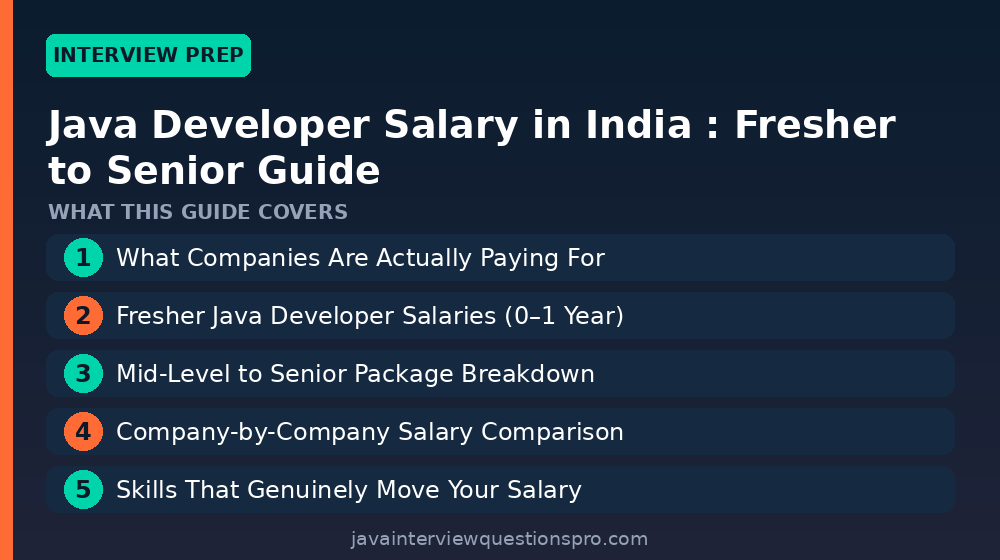
- What Companies Are Actually Paying For
- Fresher Java Developer Salaries (0–1 Year)
- Mid-Level to Senior Package Breakdown
- Company-by-Company Salary Comparison
- Skills That Genuinely Move Your Salary
- Common Salary Negotiation Mistakes and Fixes
- Frequently Asked Questions
- Three Concrete Next Steps
What Companies Are Actually Paying For
Before the numbers, understand the logic. Service companies like TCS, Infosys, and Wipro hire at volume. Their base salaries are benchmarked against each other, not against the market. Product companies and consultancies like EPAM compete for a smaller pool of engineers who can actually design systems — so they pay differently, and the gap is real.
What shifts your salary in any company is demonstrable depth. Not “I know Spring Boot” but “I debugged a memory leak in a Spring Boot microservice under load using jconsole and fixed an unbounded thread pool.” That specificity is what separates a 6 LPA offer from a 12 LPA offer at the same experience level.
In 2026, the skills commanding premiums are: microservices architecture (not just building them, but designing for failure), Java 17/21 features (records, sealed classes, virtual threads via Project Loom), reactive programming with Spring WebFlux, and cloud-native deployment on AWS or GCP. Every interviewer at a product company will probe at least two of these.
Fresher Java Developer Salaries (0–1 Year)
Fresher packages have a wider spread than people expect. Your college tier, the company’s business model, and whether you cleared a specific technical bar all matter more than your GPA.
Typical Fresher Ranges in 2026
| Company Type | Base CTC (LPA) | Variables/Perks | Realistic Take-Home/Month |
|---|---|---|---|
| TCS (NQT/Digital hire) | 3.36 – 7 LPA | Performance bonus ~5–10% | ₹22,000 – ₹50,000 |
| Infosys (SE/DSE) | 3.6 – 9.5 LPA | Variable pay ~8–12% | ₹24,000 – ₹65,000 |
| Wipro (Turbo/Elite) | 3.5 – 6.5 LPA | Joining bonus ₹30k–₹50k (one-time) | ₹23,000 – ₹45,000 |
| EPAM Systems | 6 – 12 LPA | Learning stipends, certifications | ₹42,000 – ₹80,000 |
| Early-stage startup | 4 – 10 LPA | ESOPs (check vesting cliff carefully) | ₹28,000 – ₹70,000 |
The TCS Digital vs. NQT split is real. NQT hires start at 3.36 LPA. Digital hires — who clear an additional coding round — start at 7 LPA. That’s nearly double for the same degree, just because you prepared better for one test. This is the single most impactful thing a fresher can do: qualify for the premium band at service companies.
Pro tip: At Infosys, the DSE (Digital Specialist Engineer) track pays 9.5 LPA versus 3.6 LPA for a regular SE. Both roles recruit from the same campus. The differentiator is a harder DSA round. Spend two months on LeetCode medium problems before your campus placement season and you could double your starting CTC.
Mid-Level to Senior Package Breakdown
This is where the real money diverges. At 3–5 years of experience, a developer at a service company and one at a product company can easily be 15–20 LPA apart. That gap doesn’t close unless you actively jump tracks.
Experience-Based Salary Bands (2026 Estimates)
| Experience Level | Service Companies (LPA) | Product/EPAM/MNC (LPA) | Funded Startups (LPA) |
|---|---|---|---|
| 1–3 years (Junior) | 5 – 9 | 10 – 18 | 8 – 16 |
| 3–6 years (Mid-level) | 8 – 14 | 18 – 32 | 15 – 30 |
| 6–10 years (Senior) | 12 – 22 | 30 – 55 | 25 – 50 + ESOPs |
| 10+ years (Lead/Architect) | 18 – 30 | 50 – 90+ | 40 – 80 + significant equity |
Senior engineers at product companies in Bangalore, Hyderabad, and Pune are regularly pulling 40–60 LPA total compensation in 2026 if they combine strong Java internals with system design and cloud. That number includes variable pay and RSUs where applicable — base alone is typically 60–70% of the total.
Company-by-Company Salary Comparison
TCS
TCS uses a band-based structure (C0, C1, C2…). Increments are predictable but slow — typically 8–12% annually unless you clear internal promotions. The real play at TCS is to use it as a two-year credential, build your skills in whatever project you land, and then move. Lateral hires from TCS to product companies are extremely common and well-regarded.
Infosys
Infosys pays slightly better than TCS at the entry level on the DSE track. Their internal Power Programmer program can push your compensation up, but the real bottleneck is bandwidth — you need to actively seek out good projects rather than wait to be assigned one.
Wipro
Wipro’s Turbo and Elite streams follow a similar logic to TCS’s band system. Salaries are comparable to TCS, and the increment cycle runs April–June. The company has been investing in upskilling programs; if you’re on a cloud or Java modernisation project, the learning is genuine.
EPAM Systems
EPAM is genuinely different. They hire slower, test harder (expect two to three technical rounds focused on actual Java knowledge, not just DSA), and pay significantly better than the big three Indian IT firms. A 3-year developer at EPAM can earn what a 6-year developer earns at TCS. They also invest in certifications, which compounds your market value.
Startups
Startup salaries vary wildly. A Series B startup in fintech or SaaS will often match or beat EPAM on base. Pre-Series A startups may offer lower cash but meaningful ESOPs — evaluate the vesting schedule (standard is 4 years with a 1-year cliff), the last funding round, and whether the business model makes sense. Don’t take a 30% pay cut for ESOPs without doing basic due diligence.
Skills That Genuinely Move Your Salary
Not all Java knowledge pays equally. Core Java fluency is table stakes. What actually gets you competing in the 20–40 LPA band at 4–6 years of experience is a specific combination of depth and breadth.
Here’s a concrete example. Suppose you understand why ConcurrentHashMap is preferable to a synchronized HashMap in multi-threaded contexts. Good. Now, can you explain that a synchronized HashMap locks the entire map while ConcurrentHashMap in Java 8+ uses a segmented approach with CAS operations — and that in Java 17/21 the internal implementation leverages VarHandle for finer-grained atomics? That second answer gets you a different conversation entirely.
// Wrong approach — synchronizing on the whole map
Map<String, Integer> map = Collections.synchronizedMap(new HashMap<>());

// Right approach for concurrent reads/writes
Map<String, Integer> concurrentMap = new ConcurrentHashMap<>();

// Java 21 — consider virtual threads for I/O-heavy tasks
// instead of blocking thread pools
try (var executor = Executors.newVirtualThreadPerTaskExecutor()) {
    executor.submit(() -> concurrentMap.put("key", 42));
}
Virtual threads (Project Loom, stable in Java 21) are now a genuine interview topic at product companies. Knowing that they’re cheap to create (unlike platform threads, which map 1:1 to OS threads) and that they shine for I/O-bound workloads — not CPU-bound ones — separates you from candidates who just read the release notes.
Other high-value skills in 2026: Spring Boot 3.x with GraalVM native image, Kafka consumer group management, Redis caching patterns, and writing observable code (structured logging, distributed tracing with OpenTelemetry). Cloud certifications (AWS SAA, GCP ACE) can add 2–5 LPA to an offer at a product company.
Pro tip: System design skills are the single highest-leverage investment for anyone above 3 years of experience. A candidate who can credibly design a rate limiter or a notification service with back-pressure handling will consistently out-negotiate peers with the same years of experience. Practice on paper, not just in theory. Check out our advanced Java concepts guide to strengthen the foundation before tackling system design rounds.
Common Salary Negotiation Mistakes and Fixes
The most common mistake I’ve seen — and made early in my career — is anchoring to your current CTC instead of your market value. When a recruiter asks “What’s your current salary?”, they’re trying to set a ceiling. Your answer should be: “I’m targeting X based on current market rates for this role and my skill set.” Then justify X with specifics.
Second mistake: not negotiating components. Total CTC is what matters, but structure matters too. A 30 LPA offer with 40% variable is worse than a 26 LPA offer with 15% variable for most people — the predictable take-home is lower and the variable is rarely fully paid out. Always ask: what’s the fixed component, what’s the variable structure, and what’s the typical payout percentage?
Third mistake: accepting the first offer without a counter. In 15 years of watching hiring happen, I can count on one hand the times a candidate countering professionally hurt their chances. Most HR managers have a 10–20% buffer built into the initial offer. A calm, evidence-based counter (“Based on my research and the Java 21 + Kafka expertise you’re looking for, I’d expect X”) almost always results in a better outcome. If you want to brush up on the technical side before your negotiation conversations, our Java basics refresher is a solid starting point.
Frequently Asked Questions
What is the average Java developer salary in India for freshers in 2026?
Freshers at service companies like TCS and Wipro typically start between 3.36–7 LPA depending on the hiring band. Product companies and EPAM pay 6–12 LPA for freshers who clear their more rigorous technical rounds. Qualifying for premium tracks (TCS Digital, Infosys DSE) is the fastest way to double your starting package.
How much does a Java developer with 3–5 years of experience earn in India?
At service companies, the 3–5 year band typically falls between 8–14 LPA. At product companies, EPAM, or well-funded startups, the same experience level commands 18–30 LPA. The gap comes down to demonstrable depth in microservices, system design, and modern Java features — not just years on a resume.
Is EPAM better than TCS or Infosys for Java developers?
For compensation and technical growth, EPAM is significantly better — their packages are often 1.5–2x comparable service company roles. The tradeoff is a harder hiring bar; expect multiple rounds testing real Java knowledge and system design. If you’re willing to prepare properly, the investment in clearing their process pays off quickly.
What skills should a Java developer learn in 2026 to maximize salary?
Java 21 (especially virtual threads via Project Loom), Spring Boot 3.x, one cloud platform (AWS or GCP), Kafka, and system design fundamentals are the current high-leverage investments. Cloud certifications can add 2–5 LPA to offers at product companies. Reactive programming with Spring WebFlux is increasingly asked at senior rounds.
How do I negotiate a higher Java developer salary in India?
Anchor to your market value, not your current CTC — research comparable roles and state a target with justification. Always ask about the fixed vs. variable split, since a high CTC with 40% variable can mean lower reliable take-home than a lower headline number. A competing offer is the single most effective negotiation tool, so interview at multiple places even if you have a preference.
Do startups in India pay more than Infosys or TCS for Java developers?
Series B and later funded startups in fintech or SaaS often match or beat the big three on base salary and can add meaningful ESOPs on top. Pre-Series A startups may offer lower cash; evaluate the business model, funding runway, and vesting schedule (4 years with 1-year cliff is standard) before accepting a pay cut for equity.
Three Concrete Next Steps
- Audit your current skill gap against the 20+ LPA checklist: Java 17/21 features, Spring Boot 3.x, one cloud platform, one messaging system (Kafka or RabbitMQ), and basic system design. Be honest. Most gaps close in 3–6 months of deliberate practice.
- Get a competing offer before you negotiate: The single most effective negotiation tool is a real offer from a second company. Even if you prefer the first company, a competing number gives you leverage and data. Interview broadly, not just where you plan to join.
- Track compensation, not just salary: Look at your total comp — base, variable, ESOPs, learning budget, and remote flexibility. A 5 LPA difference in base between a Bangalore in-office role and a remote role sometimes disappears once you factor in rent and commute. Use sites like levels.fyi and official job postings to sanity-check your expectations, and keep revisiting the premium interview prep resources to stay sharp technically.